
Harvesting the Outcomes
CENTAL’s NIBA Program Phase Two Scores Success in Ending the Corruption Conundrum
By: Edward W. Blamo and Gerald D. Yeakula
Liberia’s quest to end corruption is gaining steam, not just from the increased level of awareness about the existence of the menace but the wave of innovative approaches which are contributing to curbing the corruption scourge. And without any doubt, the Center for Transparency and Accountability in Liberia (CENTAL) has contributed and continues to play its part in changing the narrative. Through its National Integrity Building and Anti-corruption Program (NIBA) funded by the government and people of Sweden, a horde of approaches which have already been implemented are yielding positive outcomes.
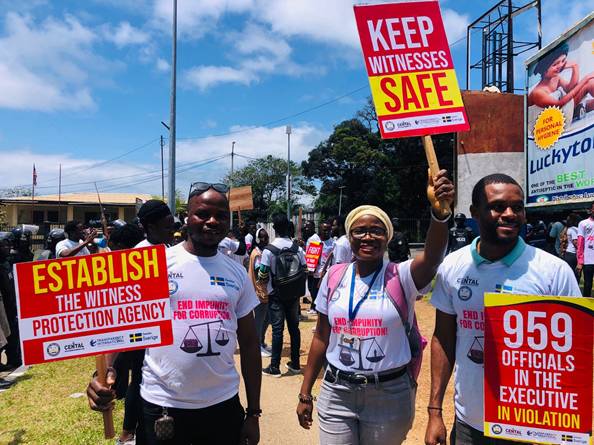 These initiatives include the Advocacy and Legal Advice Center (ALAC), an independent platform that allows citizens to report corruption; National Integrity Forum (NIF), a collaborative effort with government anti-graft institutions that promotes transparency in service delivery; Joint Civil Society and Anti-corruption Initiative, (JOSCAI), a conglomeration of community-based organizations working to tackle corruption; Youth Engagement Program - Integrity Club (IClub), an initiative that works with students to become anti-corruption ambassadors; Open Expenditure Initiative (OEI), a program that promotes transparency and inclusivity in the expenditure of county social development fund;, media and visibility, amongst others.
Several positive outcomes have already been achieved so far. For example, an allegation of corruption reported to our Advocacy and Legal Advice Center (ALAC) in 2022 has been adjudicated and a guilty verdict rendered in 2024 by Criminal Court “C” Judge Kennedy Peabody. The matter was centered around the mismanagement of funds in the tone of $96, 875.00 involving several former and current officials of the Planned Parenthood Association of Liberia (PPAL) including Madam Miatta K.K. Cojolo, former Executive Director, Ernree Bee Neeplo, former Program Manager, Ernest Vobah, former Finance and Administrative Manager, William Gibson, former Human Resource Manager, and Peter Collins, Board Vice Chairman.
These experiences have spurred us to work to build capacity of those public offices with a view to getting them to comply with relevant anti-corruption laws. “The training on anti-corruption laws has been rewarding for us especially so that we are new council”, said J. Aaron Sackie Fenlah, Chairman, Bong County Council of the capacity building session organized for members as part of CENTAL’s Open Expenditure Initiative (OEI). Another leg of capacity-building support was provided to local authorities including the Superintendent and other officials of Grand Cape Mount County on corruption prevention strategies, the management team of the Liberia Water and Sewer Cooperation (LWSC), the leadership of the Liberia National Police (LNP), amongst others.
On the other hand, the sum of US$2000 of the Gbarpolu County Disabled Community Development fund which was said to have been mismanagement by Sunny M. Winnie, former chair of the disabled community was ordered refunded. This follows CENTAL’s County Field Officer consistent highlight of the incident.
Also, the program has worked to entrench the culture of transparency and accountability within public service delivery through the conduct of a varied of anti-corruption and capacity building trainings for public sector officials, media, and other actors.
From honing the skills of senior managers of the Liberia Electricity Corporation (LEC) in the deployment of best practices to curb corruption to the training of County council members on accountability strategies for improved service delivery, the different capacity-building supports have strengthened public institutions' capacities to provide improved services.
Due to the significant role, the media plays in holding public officials to account, separate training sessions were conducted for journalists assigned at the national legislature, the Executive Mansion, and the Ministry of Information Cultural Affairs and Tourism (MICAT), including those regularly honoring CENTAL’s press conference invitations, on anti-corruption laws and accountability strategies.
One groundbreaking outcome of the program so far is the launch of the Corruption Case Tracker, an online repository of everything corruption including allegations, cases, and their statuses amongst others. The tracker, a feature of CENTAL’s website is being achieved through a close collaboration with stakeholders including the Liberia Anti-Corruption Commission (LACC), General Auditing Commission (GAC), and others.
As an army of young people against corruption, the Integrity Club Outreach Program (ICLUB) is active in four universities –United Methodist University (UMU), University of Liberia (UL), Stella Maries Polytechnic University (SMPU), and the African Methodist Episcopal University (AMEU) has accelerated outreach activities with students at the forefront. Also, members of the ICLUB have conducted a ‘corruption risk assessment’ initiative to examine the risks and danger of corruption within schools as part of an effort to help curb the pervasive nature of the menace. Augustina Appleton, Vice President of the Integrity club chapter, University of Liberia who joined in 2021 said the education gained from involvement with IClub activities has led to an improved engagement with the local community leadership. “Through the IClub, I am currently serving as the secretary for my community. Additionally, my community has asked me to run for public relations officer position during the next election. This is all happening due to my involvement with the integrity club.”
These activities are contributing to the overall vision to ensure that promoting accountability and increasing citizens' demand for accountability are placed at the front and center of national discourses in Liberia.
Despite these efforts, fighting corruption in Liberia still remains somehow cumbersome. When one is indicted for any act of corruption and the matter is not finalized within five years, he or she is deemed free of all charges and could parade the streets of Monrovia with a head lifted high and chest popped up- thanks to a statute of limitation clause in the panel law of Liberia. This scenario is just one of several legal and political roadblocks that need to be cleared to end the pervasive nature of corruption which has wreaked havoc on the livelihoods of citizens.
Already, successive global anti-corruption ratings have been dismal. For example, the 2023 Corruption Perception Index (CPI) released by Transparency International gives a 25 out of 100 score, a huge decline from 32 scored in 2018. All of these have signaled the need for concerted efforts from diverse actors including government, civil society, media, and citizens, to change course.