
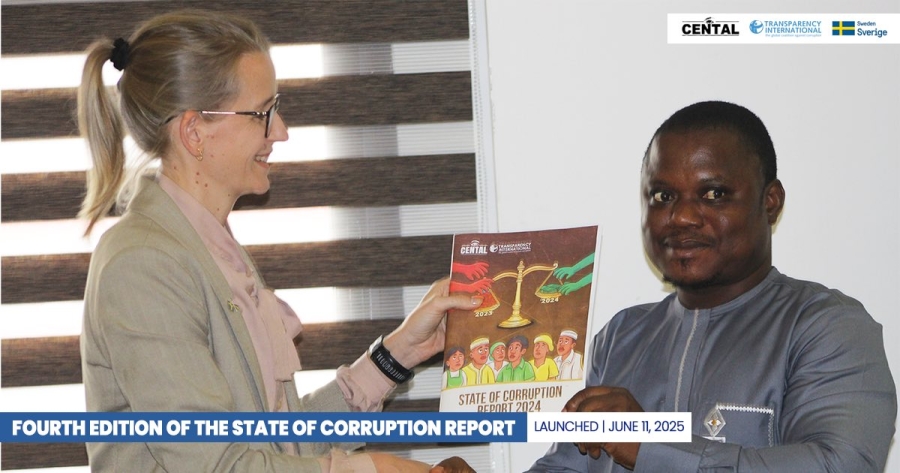
Sweden was Never Wrong To Trust Us
There’s no denying that the civil war (1989-2003) affected the viability of state and non-state institutions. Civil society institutions emerging after the conflict were confronted by a poor economy, bad governance, and a deflated donor landscape.
It was this environment that CENTAL encountered and endured since its establishment in 2004. For the forebearers, a firm conviction that Liberia can be corruption-free is what was needed to keep the torch burning. Thus, limited availability of resources and threats and opposition from government could not dissuade them from pursuing an objective in the public interest. Lack of salaries for staff, inadequate staffing, limited office space, and inadequate logistics and funding for program interventions were amongst challenges that beset the organization.
In the years that followed, CENTAL began to earn the trust of different donors, including: the Open Society Initiative West Africa (OSIWA), United States Agency for International Development (USAID), United Nations Development Programme (UNDP), and the German International Cooperation Society (GIZ). With resources at its disposal, the organization began to rollout interventions in sectors such as natural resources and education while remaining robust in its advocacy for anti-corruption reforms.
While earlier partnerships with donors propelled CENTAL to great heights of impact, these fell short of addressing capacity and sustainability challenges of the organization. Attention was mostly placed on project activities and related outcomes with very little consideration on institutional capacity or the life of the organization beyond a given project period. For instance, a proje5ct lasted for a year on average and, in many cases, did not undertake to pay other staff essential to the project and the smooth running of the organization. Donors preferred vehicle rental to vehicle purchase, even in cases were amount for rental could clearly purchase a vehicle. Administrative costs indirectly related to the projects could hardly come by to support institutional sustainability.
By 2017, however, CENTAL would become exposed to what would later be revealed as a ‘life-changing’ encounter. The Embassy of Sweden approached CENTAL over the possibility of holding activities in commemoration of International Anti-Corruption Day (IACD). Without hesitation and with support from the Embassy of Sweden, CENTAL organized activities celebrating IACD for three successive years. Then in August 2020, a partnership agreement was finally executed between CENTAL and the Embassy of Sweden with focus not only on the fight against corruption but enhancing the viability and contribution to the sustainability of CENTAL.
Since 2020, the Center for Transparency and Accountability in Liberia (CENTAL) and the government and people of Sweden through the Swedish International Development Cooperation Agency (SIDA) have enjoyed a healthy and rewarding marriage which has significantly addressed challenges facing the organization.
The initial 15 million SEK (US$1.8 million) agreement was indeed pivotal in supporting the implementation of a National Integrity Building and Anti-Corruption Program (NIBA) with objectives including Increasing Citizens’ Access to Relevant Information and Mechanisms, increasing advocacy efforts and CENTAL’s capacity to independently monitor and advocate Against Corruption in Liberia by December 2023.
As the tenure of the agreement elapsed in December 2023, discussions for the commencement of a second phase of the program were already well advanced. In February 2024, CENTAL represented by Executive Director, Anderson D. Miamen and Swedish Ambassador to Liberia Urban Sjostrom put pen to paper to consummate the agreement for a new three years program January 2024 to December 2026. The support from Sweden represents the biggest single donor support so far to CENTAL’s quest to tackle the corruption scourge since its founding in 2004, and arguably, the largest donor support to a local Civil Society Organization (CSO).
On one hand, it has enabled us to sustain partnerships with community-based organizations through a Joint Civil Society Anti-Corruption Initiative (JOSCAI) which has rallied citizens to petition members of the Legislature for the passage and amendments of anti-corruption bills. On the other hand, our Advocacy and Legal Advice Center (ALAC), has been positioned as a foremost platform for citizens to report and seek redress to corruption and get free legal advice for other pertinent issues affecting them.
Also, it has given impetus to our efforts to increase transparency and inclusivity among citizens and local county officials in the governance and management of County Social Development Funds (CSDF) through our Open Expenditure Initiative (OEI).
In a nutshell, the support from Sweden has not only strengthened the capacity of CENTAL in support of its vision of a corruption-free Liberia but it has positioned the organization as one of the leading voices in promoting accountability and integrity in Liberia.
This demonstration of trust and confidence on the part of Sweden has further opened the doors for much more support from other donors many of whom have come knocking. Because of the confidence reposed by Sweden, there has been an avalanche of new support from almost every nook and cranny of the donor community including UN Women, UNDP, IRISH Aid, and USAID amongst others.
This support from Sweden coupled with the results achieved so far in our quest to build a Liberia where good governance, a culture of accountability, and transparency remain the hallmark of governance point to one conclusion, ‘Sweden Was Never Wrong to Trust’.
To the government and people of Sweden, we raise our heads; lift up our right hand to a salute for the continuous support to not just the works of CENTAL but the tons of other local Civil Society Organizations (CSOs) in Liberia you are supporting to stay engaged and afloat.